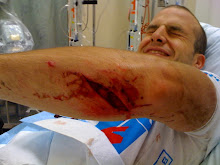
In fact, I didn't do anything against the rules. Technically.
Several of my colleagues thought my previous posts offering objective yet helpful criticism to the suggestions published by a certain corporation were risky. Or stupid. I thought they were entertaining, but apparently the suggestions that prompted the blog were a burst of brilliance and the suggestion box has now been crammed with the typically mundane "let's serve our customers better, hooray for our wonderful company" crap. In other words, nothing interesting to make fun of.
So I've started writing about the stuff that I think about most of the time and that, in addition to supporting my family, is about all that motivates me to go to work every day. If you're still reading, from now on I will be mostly writing about skiing and bicycling. I'll still try to make fun of things, though, so that part won't change.
I started skiing when I was 10. That was an Olympic year for those keeping score at home, and I was inspired to say the least. Though I no longer have any interest in racing on skis, the thrill I felt that first day on the slopes has pretty much gone unchecked since then. Even after 30 days on snow this year, I am sad to see it melt. I have never experienced anything, at least not anything I'd talk about in such a public forum, that rivals the thrill of skiing deep, light powder. It is like no other thrill in this world.
During the warmer months, I ride bikes. I started out several years ago, when I was really fat, as a road biker. I was too fat to do anything else as exercise (that's the nice thing about biking--anyone can do it). After I lost some weight, my wife and I decided to run a marathon together, and I became a runner for several years. Then I bought a mountain bike and completely lost interest in running. Two years ago, I got sick of driving to the trailhead every time I wanted a workout, so I got a road bike "just to keep in shape." Now in terms of number of days, I probably get out on the MTB more often, but I spend more total hours on the road bike. Both are fun for different reasons.
I should also mention that I'm very geeky about the technical aspects of sports. So if why stuff works the way it does interests you, then you might enjoy what I have to say. My sisters, if they ever read this, will just roll their eyes and wonder whether we are really related.
Saturday, March 29, 2008


Wednesday, February 6, 2008
Conference call madness
Sorry for the long layoff. I'm consistently inconsistent, particularly when it comes to blog posts. Besides, it's been snowing like never before in the Western US, so in my spare time I've been skiing instead of blogging. If you've never been in the white room before, please don't take up skiing. I don't like sharing my powder. If you have, you know why I have not been blogging.
Anyway, today's suggestion comes to us from someone who is doubtless an engineer. And doubtless NOT a human factors engineer.
[Editor's note: this is the abridged edition of the suggestion. The real suggestion was so long, if it were printed, it would provide enough paper to clean up after an Iowa hog with giardia. Had it not been so rich with insight that only a technojunkie would find useful, I doubt I could have made it through the entire thing. I once spent nearly an entire summer reading the unabridged edition of Les Miserables, and the 100+ pages about the Battle of Waterloo whose only purpose were to introduce Msr. Thenardier and let us know what a singular low-life he was were in fact a far more concise bit of prose than the seven paragraphs rendered by our faithful employee towards the critical end of improving conference call technology.]
So let's start by summarizing here. You want to add the following features to the conference call:
1. A call ended indicator that will let people who dial in late know that the call is already over.
2. A callback feature that, should you dial in before the chairperson initiates the call, will call you back and allow you to rejoin.
3. An overlap feature that will prevent people who dial in on-time for the next call on the same line from participating in the previous call if it runs over.
4. Enabling feature "2" to work in conjunction with feature "3."
There is actually existing technology that has been around for quite some time that renders all four of these suggestions moot. It's called a clock. Perhaps you have heard of it. It tells you what time it is, so that you know whether or not to begin your meeting. It also works at the end of the meeting to make sure that you conclude on-time. Really quite a remarkable bit of innovation, and from what I understand, quite the little cottage industry in Switzerland. Moreover, with the advent of the Internet, it's now possible for all of the clocks on all of the computers within a company or even throughout the world to be synchronized, thereby eliminating the chance that some participant or another has not set his clock correctly.
However, even if you and all of the participants in your meeting are in possession of working clocks, that does not necessarily eliminate the possibility of tardiness. Your first suggestion, a "call ended" indicator would help those who suffer from chronic tardiness to know when said tardiness has forced them to miss the meeting in its entirety. Here's a clue, though, since you obviously seem to be missing your allotment: if you are late for a call, you dial in, and nobody is there, the call is over. It is never yet to start. So instead of hoping for something to tell you outright what is obvious to the rest of us, hang up and call one of your colleagues if you still insist on verifying that the call already ended without you. If you really insist on having this feature, though, I guess it would be alright if the indicator were a recorded message that said "late again, idiot, you missed the meeting."
Feature "2" is an interesting suggestion. But here's a better one: sit there and enjoy the hold music and work on something else. If the chairperson is in possession of a working clock and does not suffer from chronic tardiness, you'll lose more productivity entering the information for the callback, waiting for the callback, and then rejoining the call than you will just sitting tight for a few minutes. Deal with it.
And I reject your assertion that feature "3," an anti-overlap feature, would be a good thing. Most of the time when a call runs over, it's not because I or anyone who actually does work wanted it to. So when other people start dialing into the line intent on discussing something else, this forced terminus of the topic at hand can be the only thing that saves me from completely losing patience. If you took this feature away, the term "going postal" would probably be replaced by "going huge company."
"Feature 4," however, is a good idea. Seriously, it is. In fact, why don't you start working on a way to integrate feature 4 without feature 1, 2, or 3. Spend as much time on it as you can, even if your manager asks you to do something else and warns you that you're off task. I promise, it will pay off eventually. Not necessarily for you, but it will pay off. Thanks for the suggestion!
Anyway, today's suggestion comes to us from someone who is doubtless an engineer. And doubtless NOT a human factors engineer.
I spend quite a lot of time on conference calls, which also means a fair amount of time listening to hold music waiting for the conference call to begin. Why not add a call-back feature that saves us from being on hold waiting for the chairperson to arrive? And in case we arrived late and the meeting has already ended, why not add a "call ended" feature, so that I don't sit on hold wondering whether the call is delayed when in fact it's over? While we're at it, we could also add an overlap feature that would prevent the next meeting's attendees from listening in to the end of the previous call if it happens to go over. This anti-overlap feature could work in conjunction with the callback feature to help make things more efficient and reduce telecom costs for the company.
[Editor's note: this is the abridged edition of the suggestion. The real suggestion was so long, if it were printed, it would provide enough paper to clean up after an Iowa hog with giardia. Had it not been so rich with insight that only a technojunkie would find useful, I doubt I could have made it through the entire thing. I once spent nearly an entire summer reading the unabridged edition of Les Miserables, and the 100+ pages about the Battle of Waterloo whose only purpose were to introduce Msr. Thenardier and let us know what a singular low-life he was were in fact a far more concise bit of prose than the seven paragraphs rendered by our faithful employee towards the critical end of improving conference call technology.]
So let's start by summarizing here. You want to add the following features to the conference call:
1. A call ended indicator that will let people who dial in late know that the call is already over.
2. A callback feature that, should you dial in before the chairperson initiates the call, will call you back and allow you to rejoin.
3. An overlap feature that will prevent people who dial in on-time for the next call on the same line from participating in the previous call if it runs over.
4. Enabling feature "2" to work in conjunction with feature "3."
There is actually existing technology that has been around for quite some time that renders all four of these suggestions moot. It's called a clock. Perhaps you have heard of it. It tells you what time it is, so that you know whether or not to begin your meeting. It also works at the end of the meeting to make sure that you conclude on-time. Really quite a remarkable bit of innovation, and from what I understand, quite the little cottage industry in Switzerland. Moreover, with the advent of the Internet, it's now possible for all of the clocks on all of the computers within a company or even throughout the world to be synchronized, thereby eliminating the chance that some participant or another has not set his clock correctly.
However, even if you and all of the participants in your meeting are in possession of working clocks, that does not necessarily eliminate the possibility of tardiness. Your first suggestion, a "call ended" indicator would help those who suffer from chronic tardiness to know when said tardiness has forced them to miss the meeting in its entirety. Here's a clue, though, since you obviously seem to be missing your allotment: if you are late for a call, you dial in, and nobody is there, the call is over. It is never yet to start. So instead of hoping for something to tell you outright what is obvious to the rest of us, hang up and call one of your colleagues if you still insist on verifying that the call already ended without you. If you really insist on having this feature, though, I guess it would be alright if the indicator were a recorded message that said "late again, idiot, you missed the meeting."
Feature "2" is an interesting suggestion. But here's a better one: sit there and enjoy the hold music and work on something else. If the chairperson is in possession of a working clock and does not suffer from chronic tardiness, you'll lose more productivity entering the information for the callback, waiting for the callback, and then rejoining the call than you will just sitting tight for a few minutes. Deal with it.
And I reject your assertion that feature "3," an anti-overlap feature, would be a good thing. Most of the time when a call runs over, it's not because I or anyone who actually does work wanted it to. So when other people start dialing into the line intent on discussing something else, this forced terminus of the topic at hand can be the only thing that saves me from completely losing patience. If you took this feature away, the term "going postal" would probably be replaced by "going huge company."
"Feature 4," however, is a good idea. Seriously, it is. In fact, why don't you start working on a way to integrate feature 4 without feature 1, 2, or 3. Spend as much time on it as you can, even if your manager asks you to do something else and warns you that you're off task. I promise, it will pay off eventually. Not necessarily for you, but it will pay off. Thanks for the suggestion!
Thursday, January 17, 2008
Anyone can make a faster chip
Editor's note: In addition to practical business suggestions, employees also submit inspirational quotes. Today's post is based on one I found quite inspirational indeed.
"Anyone can build a faster CPU. The trick is to build a fast system"
--Seymour Cray
I find this quote remarkable, and indeed most inspirational. To think that I, a lowly Powerpoint slide maker, can refocus my attention and make a faster chip is truly energizing. But why should I keep this pleasure all to myself? Instead of hogging the glory of making a faster chip, I think I will share this joy with my family. So tonight, my preschooler and I will commence work on a faster chip. It really shouldn't be hard--he's got lots of lego blocks and toy trains. And I'm sure I've got some wires and other stuff in the garage. We might have to buy a few switches and a soldering iron from the hardware store, but I'm pretty sure we can have something put together before too long.
OK, who am I kidding. Despite my advanced degree and years of experience in the industry, I could no more make a chip, let alone a faster one, than teleport myself to Dubai. In fact, I find Mr. Cray's choice of the word "anyone" to be quite interesting. While I'm sure there are exceptions here and there, I think "anyone" would be limited to electrical engineers, who make up 0.25% of the workforce in the United States.
Just for simplicity sake, let's say that Electrical Engineers constitute 0.25% of the workforce worldwide, knowing that in some countries it will be higher (Taiwan and S. Korea, for instance), and in some countries it will be lower (say, Haiti or Kenya). Given that only about half of the population is actually in the workforce, 0.25% of the roughly 3,000,000,000 workers in the world is 7,500,000 Electrical Engineers. Now according to the most infallible of all sources, Wikipedia, there are eight major subdivisions within the field of electrical engineering, so let's say, again for simplicity, that roughly 1/8 of our pool are working in microelectronics. Rounding up, that leaves us with an even million worldwide.
Of course, building a faster CPU means that you work for a firm that builds that kind of chip. There are probably 600-700 companies making semiconductors, but only about six or seven that actually make CPUs. Now these six or seven are among the largest, so let's assume that they have about 10% of the engineers. We're down to 100,000 engineers making chips. But 20% of these folks are managers, so we know they're not actually coming up with the ideas, so we're down to 80,000. Another 20% have changed jobs in the last year, so even if they're on the key projects, they haven't come up to speed to the point of actually making a contribution. So at best, when you say "anyone," what you really mean is the 60,000 who might be in a position to contribute to such a project out of the 6,000,000,000 or so people worldwide, or one out of every 100,000 of us.
To put that into perspective, if you live in the United States, you are five times more likely to be murdered than to make a faster chip. You are 460 times more likely to get cancer than to make a faster chip. You are 9 times more likely to bowl a 300 game, 20 times more likely to get a hole in one, 27 times more likely to injure yourself mowing the lawn, 800 times more likely to die this year, 455 times more likely to write a New York times bestseller, 6,700 times more likely to have diabetes, 177 times more likely to catch a ball at a major league baseball game, and even 1.1 times more likely to date a supermodel. That's quite an interesting definition of "anyone."
Indeed, some of the few things that you're less likely to do than build a faster chip are win an Olympic medal (6.6 times less likely), win the Powerball lottery (1,461 times less likely), or get canonized (200 times less likely), all of which I would take over building a faster chip for the simple reason that building it is one thing, but selling it for a profit is quite another.
Oh, and as for the part about "the trick is to build a faster system," who cares? Because even if you did build a faster system, Apple would build one that's smaller and more fashionable, and Google would build one that's free.
"Anyone can build a faster CPU. The trick is to build a fast system"
--Seymour Cray
I find this quote remarkable, and indeed most inspirational. To think that I, a lowly Powerpoint slide maker, can refocus my attention and make a faster chip is truly energizing. But why should I keep this pleasure all to myself? Instead of hogging the glory of making a faster chip, I think I will share this joy with my family. So tonight, my preschooler and I will commence work on a faster chip. It really shouldn't be hard--he's got lots of lego blocks and toy trains. And I'm sure I've got some wires and other stuff in the garage. We might have to buy a few switches and a soldering iron from the hardware store, but I'm pretty sure we can have something put together before too long.
OK, who am I kidding. Despite my advanced degree and years of experience in the industry, I could no more make a chip, let alone a faster one, than teleport myself to Dubai. In fact, I find Mr. Cray's choice of the word "anyone" to be quite interesting. While I'm sure there are exceptions here and there, I think "anyone" would be limited to electrical engineers, who make up 0.25% of the workforce in the United States.
Just for simplicity sake, let's say that Electrical Engineers constitute 0.25% of the workforce worldwide, knowing that in some countries it will be higher (Taiwan and S. Korea, for instance), and in some countries it will be lower (say, Haiti or Kenya). Given that only about half of the population is actually in the workforce, 0.25% of the roughly 3,000,000,000 workers in the world is 7,500,000 Electrical Engineers. Now according to the most infallible of all sources, Wikipedia, there are eight major subdivisions within the field of electrical engineering, so let's say, again for simplicity, that roughly 1/8 of our pool are working in microelectronics. Rounding up, that leaves us with an even million worldwide.
Of course, building a faster CPU means that you work for a firm that builds that kind of chip. There are probably 600-700 companies making semiconductors, but only about six or seven that actually make CPUs. Now these six or seven are among the largest, so let's assume that they have about 10% of the engineers. We're down to 100,000 engineers making chips. But 20% of these folks are managers, so we know they're not actually coming up with the ideas, so we're down to 80,000. Another 20% have changed jobs in the last year, so even if they're on the key projects, they haven't come up to speed to the point of actually making a contribution. So at best, when you say "anyone," what you really mean is the 60,000 who might be in a position to contribute to such a project out of the 6,000,000,000 or so people worldwide, or one out of every 100,000 of us.
To put that into perspective, if you live in the United States, you are five times more likely to be murdered than to make a faster chip. You are 460 times more likely to get cancer than to make a faster chip. You are 9 times more likely to bowl a 300 game, 20 times more likely to get a hole in one, 27 times more likely to injure yourself mowing the lawn, 800 times more likely to die this year, 455 times more likely to write a New York times bestseller, 6,700 times more likely to have diabetes, 177 times more likely to catch a ball at a major league baseball game, and even 1.1 times more likely to date a supermodel. That's quite an interesting definition of "anyone."
Indeed, some of the few things that you're less likely to do than build a faster chip are win an Olympic medal (6.6 times less likely), win the Powerball lottery (1,461 times less likely), or get canonized (200 times less likely), all of which I would take over building a faster chip for the simple reason that building it is one thing, but selling it for a profit is quite another.
Oh, and as for the part about "the trick is to build a faster system," who cares? Because even if you did build a faster system, Apple would build one that's smaller and more fashionable, and Google would build one that's free.
Wednesday, January 16, 2008
Lightsource for using notebook computers in the dark would be valuable feature
I often use my laptop in bed at night with all the lights off while my wife is sleeping but find it difficult to find all the right keys to enter my password. This is a problem wherever I use my notebook in the dark, such as riding in the back seat of a car or on a bus or train. Why don't we add a small light to the notebook that would illuminate the keys, thus enabling users to find the right keys in the dark?
First of all, if you find yourself frequently using your laptop in bed, after dark, while your wife is asleep, then finding the right keys is the least of your problems. What exactly are you doing on the computer, anyway? Couldn't you just go into another room where it's OK to have the lights on and then go to bed when you're finished?
But it sounds like your bed is not the only place you like to use your notebook, since you also mentioned the back seat of cars and buses as other darkened settings where computer use is imperative. Which begs the question: do you ever not use that thing? Here are a couple of suggestions to help you solve your keyboarding problem.
1. Learn to type. With all ten fingers. I know it sounds difficult, but trust me on this one, it's possible. They teach people how to use keyboards at schools for the blind all the time, and I know from first-hand experience that sighted people are also able to learn to type without looking at the keys. Sure, it's kind of hard at first, but with the amount of time you apparently spend on your notebook computer, I'm sure you'll eventually get the hang of it. Your keyboard is even conveniently equipped with with small tabs on two of the keys to help you get your fingers in the right place. Oh, and you might even start to type a bit faster if you're watching the screen and not your fingers, which means less time on the computer and hopefully no more need to use it after dark.
2. Get some other hobbies. I realize that there are lots of interesting things to do on the computer, such as playing solitaire, building excel spreadsheets, and reading email memos about budget cuts. But there are also ways to entertain one's self that don't involve computers. If you are riding on a bus or in the back seat of a car, chances are pretty good that there are other occupants in the vehicle. I know it seems strange to interact with someone face to face, but it might prove entertaining to talk to some of these people. In fact, if you know the people you are riding around in cars with, they may actually expect you to be talking to them and find it a bit weird that your face is buried in your notebook while you hunt and peck for your password. If you prefer not to talk, you could listen to music. Or you could skip the bus/car altogether and take up bicycling or walking as a means of transportation and exercise all at once.
3. Get some sleep. As strange as the other occupants of the vehicle likely find it that you are using your computer rather than interacting with them, I guarantee that your wife finds it even stranger that you are using the computer while in bed with her. Do you have any children, and if so, how old? That's what I thought. Try going to bed at the same time your wife does, but instead of booting up the PC (as you clearly are not a Mac user), talk with your wife. Ask her how her day went. Show some interest in what she's doing. Maybe even demonstrate a bit of affection. If you take this approach, worst-case-scenario you will get more sleep and be more productive during the day. Best case scenario, you may discover that there are things to do in bed with the lights out that are more entertaining than whatever it is you are doing on the computer.
I don't know if you've ever been given the classic breakup line, "it's not you, it's me." Well in this case, "it's not the computer, it's you." Putting a light on your notebook will no more solve your problems than making your wife's PDA waterproof so she can use it in the shower. Believe it or not, adding more technology is not the answer to most of life's problems. So learn to type, spend less time on the computer, talk to your friends, and pretend to care about your wife until you actually do. Thanks for the suggestion!
First of all, if you find yourself frequently using your laptop in bed, after dark, while your wife is asleep, then finding the right keys is the least of your problems. What exactly are you doing on the computer, anyway? Couldn't you just go into another room where it's OK to have the lights on and then go to bed when you're finished?
But it sounds like your bed is not the only place you like to use your notebook, since you also mentioned the back seat of cars and buses as other darkened settings where computer use is imperative. Which begs the question: do you ever not use that thing? Here are a couple of suggestions to help you solve your keyboarding problem.
1. Learn to type. With all ten fingers. I know it sounds difficult, but trust me on this one, it's possible. They teach people how to use keyboards at schools for the blind all the time, and I know from first-hand experience that sighted people are also able to learn to type without looking at the keys. Sure, it's kind of hard at first, but with the amount of time you apparently spend on your notebook computer, I'm sure you'll eventually get the hang of it. Your keyboard is even conveniently equipped with with small tabs on two of the keys to help you get your fingers in the right place. Oh, and you might even start to type a bit faster if you're watching the screen and not your fingers, which means less time on the computer and hopefully no more need to use it after dark.
2. Get some other hobbies. I realize that there are lots of interesting things to do on the computer, such as playing solitaire, building excel spreadsheets, and reading email memos about budget cuts. But there are also ways to entertain one's self that don't involve computers. If you are riding on a bus or in the back seat of a car, chances are pretty good that there are other occupants in the vehicle. I know it seems strange to interact with someone face to face, but it might prove entertaining to talk to some of these people. In fact, if you know the people you are riding around in cars with, they may actually expect you to be talking to them and find it a bit weird that your face is buried in your notebook while you hunt and peck for your password. If you prefer not to talk, you could listen to music. Or you could skip the bus/car altogether and take up bicycling or walking as a means of transportation and exercise all at once.
3. Get some sleep. As strange as the other occupants of the vehicle likely find it that you are using your computer rather than interacting with them, I guarantee that your wife finds it even stranger that you are using the computer while in bed with her. Do you have any children, and if so, how old? That's what I thought. Try going to bed at the same time your wife does, but instead of booting up the PC (as you clearly are not a Mac user), talk with your wife. Ask her how her day went. Show some interest in what she's doing. Maybe even demonstrate a bit of affection. If you take this approach, worst-case-scenario you will get more sleep and be more productive during the day. Best case scenario, you may discover that there are things to do in bed with the lights out that are more entertaining than whatever it is you are doing on the computer.
I don't know if you've ever been given the classic breakup line, "it's not you, it's me." Well in this case, "it's not the computer, it's you." Putting a light on your notebook will no more solve your problems than making your wife's PDA waterproof so she can use it in the shower. Believe it or not, adding more technology is not the answer to most of life's problems. So learn to type, spend less time on the computer, talk to your friends, and pretend to care about your wife until you actually do. Thanks for the suggestion!
Monday, January 14, 2008
Wildlife
Editor's Note: today's post is a deviation from the normal routine in that the suggestion is mine.
Each day as I arrive at the office, the first thing I encounter upon exiting my vehicle is goose crap. After hopscotching my way across the sidewalk in an effort to avoid avian fecal material, I next encounter food dishes for the "feral" cats that live on the campus. Once inside the building, it is not uncommon to encounter rodent traps here and there and to occasionally have the candy bowl removed from the common area due to evidence that the rodents had accessed the M&M's (to say nothing of the people who fail to wash after using the restroom).
Normally this is all I have to deal with in the way of wildlife, but last week I was in a meeting with a colleague when Mickey Mouse himself poked his beady little eyes out from under my colleague's bag, ostensibly looking for a snack while we were busy talking about forecasting (I do not recall whether the forecast was financial or meteorological in nature). Are we running a corporate petting zoo or a Fortune XX company here?
Before I delve into the solution to this zoological conundrum, let me first provide a little background information. Like many huge companies, we chose to build several of our campuses where once there were farms. This reclaimed farmland was then developed and buildings added as needed, with substantial open space left as parks and ball fields, at least until Huge Company decides it needs additional cubicles (but since the campus where I work is not in Asia, this need for additional cubicles is unlikely to occur until the value of the Dollar is overtaken by the Peso).
Of course, every farmer knows that with farms come mice. And when there is no grain on the land, the mice are forced to seek sustenance somewhere else, usually starting with the granary and then moving to the farmhouse. And when there is neither granary nor farmhouse, but instead a large, warm building that is occupied no more than 50% of the time and wherein the semi-occupants stash substantial nuts, fruits, and chocolate in cozy little drawers, it's only obvious where the mice took up residence. Mice being unsavory creatures to most, years ago when stray cats wandered onto campus, they were allowed to take up residence and do their jobs. So the cats began taking care of the mice and other vermin, which included an increasing number of geese. You see, this former farmland now planted with tall fescue and littered with man-made ponds proved an excellent habitat for formerly-migratory Canada geese.
Problems arose when certain folks decided that the geese, being only slightly more majestic than rats and cockroaches, should have nesting boxes to save the goslings from suffering the same fate as the mice, what with these feral cats running around. Certain other folks, fearing that nature's most successful hunter might starve if forced to fend for itself, began feeding the "feral" cats. And before too long, nature took its course, and we now have hundreds of geese left to reproduce unchecked, dozens of cats with an obesity rate comparable to what one would find in Polynesia, and I-don't-want-to-think-about-how-many mice who have developed a taste for Wheat Thins, cashews, M&M's, Red Vines, and leftover donuts & bagels.
The solution to this problem is rather obvious: stop feeding the cats and get rid of the nesting boxes. There is no possible way that the cats will starve to death, even in the winter. There is simply too much to eat, should they be forced to hunt for it. While I doubt that we will eliminate the indoor mice altogether, we should be able to reduce their numbers substantially if we force the cats to do their job.
To those who think my proposal is harsh or inhumane, you tell me which is worse: allowing some predators to keep the mouse and goose population at healthy levels, or having sickness and disease run unchecked? A couple of days ago, I saw a goose walking around with a broken wing. This is pretty sad to see, but what do you do about it? In nature, that goose would become food for another animal and in aggregate, both predator and prey populations would be healthier as a result. When we as humans encroach upon nature, we need to be careful to have the lightest touch possible. Which in this case means leaving the animals alone and allowing them to coexist. Which hopefully also means a lot less goose crap on the bottoms of my shoes each morning.
Each day as I arrive at the office, the first thing I encounter upon exiting my vehicle is goose crap. After hopscotching my way across the sidewalk in an effort to avoid avian fecal material, I next encounter food dishes for the "feral" cats that live on the campus. Once inside the building, it is not uncommon to encounter rodent traps here and there and to occasionally have the candy bowl removed from the common area due to evidence that the rodents had accessed the M&M's (to say nothing of the people who fail to wash after using the restroom).
Normally this is all I have to deal with in the way of wildlife, but last week I was in a meeting with a colleague when Mickey Mouse himself poked his beady little eyes out from under my colleague's bag, ostensibly looking for a snack while we were busy talking about forecasting (I do not recall whether the forecast was financial or meteorological in nature). Are we running a corporate petting zoo or a Fortune XX company here?
Before I delve into the solution to this zoological conundrum, let me first provide a little background information. Like many huge companies, we chose to build several of our campuses where once there were farms. This reclaimed farmland was then developed and buildings added as needed, with substantial open space left as parks and ball fields, at least until Huge Company decides it needs additional cubicles (but since the campus where I work is not in Asia, this need for additional cubicles is unlikely to occur until the value of the Dollar is overtaken by the Peso).
Of course, every farmer knows that with farms come mice. And when there is no grain on the land, the mice are forced to seek sustenance somewhere else, usually starting with the granary and then moving to the farmhouse. And when there is neither granary nor farmhouse, but instead a large, warm building that is occupied no more than 50% of the time and wherein the semi-occupants stash substantial nuts, fruits, and chocolate in cozy little drawers, it's only obvious where the mice took up residence. Mice being unsavory creatures to most, years ago when stray cats wandered onto campus, they were allowed to take up residence and do their jobs. So the cats began taking care of the mice and other vermin, which included an increasing number of geese. You see, this former farmland now planted with tall fescue and littered with man-made ponds proved an excellent habitat for formerly-migratory Canada geese.
Problems arose when certain folks decided that the geese, being only slightly more majestic than rats and cockroaches, should have nesting boxes to save the goslings from suffering the same fate as the mice, what with these feral cats running around. Certain other folks, fearing that nature's most successful hunter might starve if forced to fend for itself, began feeding the "feral" cats. And before too long, nature took its course, and we now have hundreds of geese left to reproduce unchecked, dozens of cats with an obesity rate comparable to what one would find in Polynesia, and I-don't-want-to-think-about-how-many mice who have developed a taste for Wheat Thins, cashews, M&M's, Red Vines, and leftover donuts & bagels.
The solution to this problem is rather obvious: stop feeding the cats and get rid of the nesting boxes. There is no possible way that the cats will starve to death, even in the winter. There is simply too much to eat, should they be forced to hunt for it. While I doubt that we will eliminate the indoor mice altogether, we should be able to reduce their numbers substantially if we force the cats to do their job.
To those who think my proposal is harsh or inhumane, you tell me which is worse: allowing some predators to keep the mouse and goose population at healthy levels, or having sickness and disease run unchecked? A couple of days ago, I saw a goose walking around with a broken wing. This is pretty sad to see, but what do you do about it? In nature, that goose would become food for another animal and in aggregate, both predator and prey populations would be healthier as a result. When we as humans encroach upon nature, we need to be careful to have the lightest touch possible. Which in this case means leaving the animals alone and allowing them to coexist. Which hopefully also means a lot less goose crap on the bottoms of my shoes each morning.
Thursday, January 10, 2008
Protection features should be built into mobile devices
I once left a camera on a train and it was never returned to me. Why not add protection features to mobile devices that allow the user to enter name and contact information visible in the startup screen, thus facilitating an easy return should a device be lost and found?
Not sure if you realize this, but the person who "found" your camera was pretty happy to find it and not know how to get in touch with you. In fact, I've had a couple of similar experiences where the person who found my stuff was unable to return it even though it was pretty easy to track me down.
Between high school and college, I spent a summer backpacking through Europe. Being a poor college student, I didn't have much money, so when we got into Berlin late one night, we ended up just sleeping on the floor in the train station. Like most people, I don't sleep with my shoes on but instead took them off and set them on my bag between me and the wall. The guy who found them stepped over my friend and me and grabbed my shoes and walked off with them. Given that they were right next to me, I think it was pretty obvious who they belonged to. And yet they were never returned. Did I mention that I didn't have enough money to even pay for a bed in a hostel let alone a new pair of shoes? Yeah, I'm pretty sure whoever took them needed them more than I did given that it was day three of a 30 day walking tour of Europe.
Or what about the time when someone found the CDs and sunglasses I had in my car? I'm sure that if I'd had a high-tech LCD display with my name and address on them that the person who found them would have known they were mine and left them there or returned them to me. But being as they were inside my vehicle, there was no way for this person to know who they really belonged to, so I never saw them again. I was pretty bummed about that one, too.
The best lost and found experience I've ever had, though, was in my high school gym class. Thinking that my sweaty gym clothes were not that valuable of a find, I didn't bother to put a lock on my locker. But one day I walked in to get dressed for class, and my shorts were missing. A couple of days later, one of the guys in my class shows up wearing these shorts. Apparently he had found them in my locker but didn't know who to return them to. I mentioned that they looked an awful lot like the shorts I was missing, but he insisted that he had purchased them at a big box retailer that didn't actually carry that brand of shorts.
I'm sure that had a technical solution been available, none of these found items would have stayed lost for very long. Because people are just that trustworthy. Think of it this way: if every found item were returned to its owner, all those folks who make their living selling stuff on eBay would be out of work. And what would that do to our economy? Thanks for the suggestion!
Not sure if you realize this, but the person who "found" your camera was pretty happy to find it and not know how to get in touch with you. In fact, I've had a couple of similar experiences where the person who found my stuff was unable to return it even though it was pretty easy to track me down.
Between high school and college, I spent a summer backpacking through Europe. Being a poor college student, I didn't have much money, so when we got into Berlin late one night, we ended up just sleeping on the floor in the train station. Like most people, I don't sleep with my shoes on but instead took them off and set them on my bag between me and the wall. The guy who found them stepped over my friend and me and grabbed my shoes and walked off with them. Given that they were right next to me, I think it was pretty obvious who they belonged to. And yet they were never returned. Did I mention that I didn't have enough money to even pay for a bed in a hostel let alone a new pair of shoes? Yeah, I'm pretty sure whoever took them needed them more than I did given that it was day three of a 30 day walking tour of Europe.
Or what about the time when someone found the CDs and sunglasses I had in my car? I'm sure that if I'd had a high-tech LCD display with my name and address on them that the person who found them would have known they were mine and left them there or returned them to me. But being as they were inside my vehicle, there was no way for this person to know who they really belonged to, so I never saw them again. I was pretty bummed about that one, too.
The best lost and found experience I've ever had, though, was in my high school gym class. Thinking that my sweaty gym clothes were not that valuable of a find, I didn't bother to put a lock on my locker. But one day I walked in to get dressed for class, and my shorts were missing. A couple of days later, one of the guys in my class shows up wearing these shorts. Apparently he had found them in my locker but didn't know who to return them to. I mentioned that they looked an awful lot like the shorts I was missing, but he insisted that he had purchased them at a big box retailer that didn't actually carry that brand of shorts.
I'm sure that had a technical solution been available, none of these found items would have stayed lost for very long. Because people are just that trustworthy. Think of it this way: if every found item were returned to its owner, all those folks who make their living selling stuff on eBay would be out of work. And what would that do to our economy? Thanks for the suggestion!
Monday, January 7, 2008
Huge Company could lead green home revolution
Before I get started with today's post, I'd like to apologize to all three of my loyal readers for the long hiatus. During the week leading up to the holiday shutdown (as the Huge Company so euphemistically and politically correctly calls the week of Christmas wherein we are required to either go on vacation or take the week off unpaid to enable the huge company to relieve itself of substantial accrued liability for unredeemed vacation time even though the policy on vacation time carryover is remarkably stingy) people actually wanted to work and get things done, so I was incredibly busy doing two weeks worth of work in one. Then I took, as required, the week of Christmas off. Then I took the next week off because I didn't feel like working. So I'm finally back. Please enjoy today's post.
Why doesn't Huge Company enter the housing market and provide energy-saving technology solutions? For instance, we could allow homeowners to use the web to manage tasks such as setting their thermostat, controlling their home security system, or programming their sprinklers. Such a solution would allow homeowners to be more efficient with their use of resources while at the same time creating a market opportunity for our products.
This is a really great suggestion. I mean, who doesn't want to save energy? When fuel prices are the only thing going up faster than the anticipated cost of our children's education, most consumers are suddenly interested in saving the Alps from looking like the Gobi. So let's look at your proposal.
The first thing you suggest is that this could save energy. Except that the hardware and software required to run all that crap remotely would undoubtedly consume more electricity than managing it from the little standalone box that is already at my house. And I don't know about you, but I'm not the kind of person who is going to go on the web each day and set my thermostat so that the house is sufficiently warm/cool by the time I get home. Why, you ask? Because the little box on my thermostat allows me to set the temperature on a timer so I don't have to think about it every day. Seems to me that setting it and forgetting about it is a lot more efficient than resetting it every single day. And I'm pretty sure that little monochrome LCD screen on the thermostat consumes less energy than a full-color web portal. Same goes for the sprinklers and security system.
Then of course, there's the issue of the hardware to run it. Since it would be web-based, it would certainly need to be upgraded every three to five years, which means toxic computer hardware parts to recycle (or more likely toss in the landfill) at the same intervals. That sounds really environmentally friendly to me. Even if the system lasted longer, we're talking about a greater volume of parts, which means more resource extraction to produce them and more energy consumption to extract, manufacture, and transport them.
So while I'm all in favor of innovation to help the environment, the economy, education, or any other aspect of our lives, let's make sure it's true innovation. Slapping a bunch of technology on something doesn't automatically make it better or more efficient. Just take a look at worldwide energy consumption since the beginning of the industrial revolution. There's a pretty tight correlation between industrialization and energy consumption. That's why Americans are 1/20 of the world population but consume 1/5 of the energy. And if we keep innovating as you've suggested, we might be able to get that 1/5 of the world's energy down to 1/4. Thanks for the suggestion!
Why doesn't Huge Company enter the housing market and provide energy-saving technology solutions? For instance, we could allow homeowners to use the web to manage tasks such as setting their thermostat, controlling their home security system, or programming their sprinklers. Such a solution would allow homeowners to be more efficient with their use of resources while at the same time creating a market opportunity for our products.
This is a really great suggestion. I mean, who doesn't want to save energy? When fuel prices are the only thing going up faster than the anticipated cost of our children's education, most consumers are suddenly interested in saving the Alps from looking like the Gobi. So let's look at your proposal.
The first thing you suggest is that this could save energy. Except that the hardware and software required to run all that crap remotely would undoubtedly consume more electricity than managing it from the little standalone box that is already at my house. And I don't know about you, but I'm not the kind of person who is going to go on the web each day and set my thermostat so that the house is sufficiently warm/cool by the time I get home. Why, you ask? Because the little box on my thermostat allows me to set the temperature on a timer so I don't have to think about it every day. Seems to me that setting it and forgetting about it is a lot more efficient than resetting it every single day. And I'm pretty sure that little monochrome LCD screen on the thermostat consumes less energy than a full-color web portal. Same goes for the sprinklers and security system.
Then of course, there's the issue of the hardware to run it. Since it would be web-based, it would certainly need to be upgraded every three to five years, which means toxic computer hardware parts to recycle (or more likely toss in the landfill) at the same intervals. That sounds really environmentally friendly to me. Even if the system lasted longer, we're talking about a greater volume of parts, which means more resource extraction to produce them and more energy consumption to extract, manufacture, and transport them.
So while I'm all in favor of innovation to help the environment, the economy, education, or any other aspect of our lives, let's make sure it's true innovation. Slapping a bunch of technology on something doesn't automatically make it better or more efficient. Just take a look at worldwide energy consumption since the beginning of the industrial revolution. There's a pretty tight correlation between industrialization and energy consumption. That's why Americans are 1/20 of the world population but consume 1/5 of the energy. And if we keep innovating as you've suggested, we might be able to get that 1/5 of the world's energy down to 1/4. Thanks for the suggestion!
Subscribe to:
Posts (Atom)

 Posts
Posts